Thursday, March 17, 2016

Professional Equality 101

When a line from a classic comes to mind, 
And offers you comfort to endure the grind

So you're relatively new at your organisation and by virtue of the pink bloom of youth and your bubbling inexperience, you may be subject to unintended patronage by those above and before you. They won't necessarily talk down but you will periodically feel like a second-class citizen in this Republic. 

Here are some instances:

1. "We all have different categories of leaves, but you will need to check if you are eligible for any."

2. "The meal card and similar benefits only apply to a certain salary bracket."

3. "Madam, you can take your car after some time when The Sir leaves."

4. "Since boss and other senior managers will not be travelling this time, you can do a day-trip. Or do you need to stay in a hotel?!"

I find that Mindfulness comes to the rescue at these times. You have less than the flash of a second where you must cheerfully remind yourself that this is not your home and you *may* need to keep this job. Good sense prevails when your face assumes a dead-pan expression and you refrain from uttering a single syllable. However, you may be unable to suppress the chuckle that comes with remembering George Orwell's Animal Farm. Because he was right in saying, "All animals are equal. But some animals are more equal than others."

Monday, July 27, 2015

Weekend frenzy with the latest blockbuster

 So I made my contribution of 150 rupees and watched Hindi cinema’s latest blockbuster movie – the Salman Khan starring Bajrangi Bhaijaan (also introducing the little girl driving the world crazy with her cuteness). It’s incredible that my little cousins, aged 8 and 11 years, were insistent on watching this movie in the theatre. It will be out on tv in a month, I argued. But no, they had to see it the opening weekend. Kids these days, I tell you. And it wasn’t even marketed as a children’s movie (the way that Hrithik Roshan’s Krish series are – did you catch that sound in the background? That was my heart breaking all over again at the remembrance of the recent Krish movie).

Another 500 rupees spent as the kids need to eat cheese popcorn and drink water (mixed with coke). Multiplex culture has really caused us to lose the value of hard-earned money.

I am aware of the introductory song – presenting the hero in all his glory, mostly physical. All those hours spent in the gym have been finally brought to fruition. Roll camera, hoots and whistles. I do realise some of the elements of this so-called formula when I watch these movies on tv but there’s the magic of the big screen. It reinforces the cult of the ordinary man/superhero – he is broader (Ajay Devgn's Singham reportedly had a “solah ka dola, chavalis ki chaati” – 16 inches of biceps and chest measuring 44 inches!) but is simple as a lamb with a heart of gold.

As Bhai’s character unfolded, I recalled him in recent (similar?) roles. A pehelwaan with the perfect blend of simplicity and wit, who has an incredible talent to beat up people, but you know what? He only beats up the wrong people – because in his heart, he is really a good guy, so good that sometimes no one even knows about this secret goodness. It is revealed to both heroine and audience much later to make us guilt-trip for the audacity to doubt such a man (Ref: Dabangg series and Wanted). And even if he does display the occasional blemish in character, like say hitting on the heroine, he is only being human, no? Even then, he is better than most of us, and larger than life itself (Ref: Kick). Such characters do not really require Bhai to act, because, hello, isn’t he the exact guy in real life? Strong and six-packed (or is it eight these days?), helpful and generous, but so misunderstood, papam. It’s unfair, really.

I refrain from saying much about the movie itself – there was sometimes a little too much of it, whether it was comic relief or the feelings. It just gave me a headache. I’m not downing this kind of mass movie – why it is made or why it is popular – it is made because it will be popular and it becomes popular because it is made. That’s just how it is. Because really, we are all equal even if we are different in class, caste, creed, or nationality *.

(* Terms and conditions apply. Offer valid till stocks [or convenience] last[s])


Source: Scoopwhoop


Sunday, July 12, 2015

My books this year and the highlights therein

Covers that catch your fancy or titles that grip your brain,
It’s a pursuit in which there’s nothing to lose and everything to gain.

It’s a list that never comes to an end,
Whether I buy them, borrow or lend.

The authors of classics, the legends of yore,
The writers of today, new on the fore.

Paperback, hardcover or on virtual device,
Read them as you like, in any crevice.

With a cup of hot brew, or cold if you wish,
Or if you’d much rather, enjoy with a dish.

My friend Mehak has written eloquently about the merits of an e-book reader, in particular, the Kindle Paperwhite. So I’m hoping that it will suffice for me to say that it is one of the most convenient products ever made and instead write about my reading list for this year.
The following are the books I’ve been fortunate to be able to read this year:

1.    The Perks of Being a Wallflower, by Stephen Chbosky: a worthwhile read to remind yourself what it is to feel young and vulnerable, yet infinite.

So I guess we are who we are for a lot of reasons. And maybe we’ll never know most of them. But even if we don’t have the power to choose where we come from, we can still choose where we go from there. We can still do things. And we can try to feel okay about them.

I think that if I ever have kids, and they are upset, I won’t tell them that people are starving in China or anything like that because it wouldn’t change the fact that they were upset. And even if somebody else has it much worse, that doesn’t change the fact that you have what you have. Good and bad. It’s just different. Maybe it’s good to put things into perspective, but sometimes, I think that the only perspective is to really be there. Because it’s okay to feel things. And be who you are about them.

2.       The Bell Jar, by Sylvia Plath: What I learnt from this book is that it is not delusional to be unhappy and feel dissatisfied with your lot in life, even if you don’t know why.

After nineteen years of running after good marks and prizes and grants of one sort and another, I was letting up, slowing down, dropping clean out of the race. The trouble was, I had been inadequate all along. I simply hadn’t thought about it. The one thing I was good at was winning scholarships, and that era was coming to an end.

I felt like a racehorse in a world without racetracks or a champion college footballer suddenly confronted by Wall Street and a business suit, his days of glory shrunk to a little gold cup on his mantel with a date engraved on it like the date on a tombstone.
I saw my life branching out before me like the green fig in the story. I saw myself sitting in the crotch of this fig tree, starving to death, just because I couldn’t make up my mind which of the figs I would choose. I wanted each and every one of them, but choosing one meant losing all the rest, and, as I sat there, unable to decide, the figs began to wrinkle and go black, and, one by one, they plopped to the ground by my feet.

3.       The Book Thief, by Marcus Zusak: anybody who has ever enjoyed reading must read this book.

When she came to write her story, she would wonder exactly when the books and the words started to mean not just something, but everything. Was it when she first set eyes on the room with shelves and shelves of them?

Certainly, her brother practically died in her arms. Her mother abandoned her. But anything was better than being a Jew.

4.       The Fault in our Stars, by John Green: because even though love is without hope, we can all be hopeless romantics sometimes.

The oblivion fear is something else, fear that I won’t be able to give anything in exchange for my life. If you don’t live a life in service of a greater good, you’ve gotta at least die a death in service of a greater good, you know? And I fear that I won’t get either a life or a death that means anything.

I would probably never again see the ocean from thirty thousand feet above, so far up that you can’t make out the waves or any boats, so that the ocean is a great and endless monolith. I could imagine it. I could remember it. But I couldn’t see it again, and it occurred to me that the voracious ambition of humans is never sated by dreams coming true, because there is always the thought that something might be done better and again.

5.       The Outsiders, by John Clements: because it's never too late to read a coming of age book.

Rat race is a perfect name for it, she said. We’re always going and going and going, and never asking where. Did you ever hear of having more than you wanted? So that you couldn’t want anything else and then started looking for something else to want? It seems like we’re always searching for something to satisfy us, and never finding it. Maybe if we could lose our cool, we could.

6.       Looking for Alaska, by John Green: you like one title, so you have to read others, simple.

I go to seek a Great Perhaps.’ That’s why I’m going. So I don’t have to wait until I die to start seeking a Great Perhaps.
Jesus, I’m not going to be one of those people who sits around talking about what they’re gonna do. I’m just going to do it. Imagining the future is a kind of nostalgia.
You spend your whole life stuck in a labyrinth, thinking about how you’ll escape it one day, and how awesome it will be, and imagining that future keeps you going, but you never do it. You just use the future to escape the present.

And what is an “instant” death anyway? How long is an instant? Is it one second? Ten? The pain of those seconds must have been awful as her heart burst and her lungs collapsed and there was no air and no blood to her brain and only raw panic. What the hell is instant? Nothing is instant. Instant rice takes five minutes, instant pudding an hour. I doubt that an instant of blinding pain feels particularly instantaneous.

7.       Anna Karenina, by Leo Tolstoy: it was a worthwhile and moving read, despite the length and mundane parts.

It’s the truth I’m telling you. I do value my idea and my work awfully; but in reality only consider this: all this world of ours is nothing but a speck of mildew, which has grown up on a tiny planet. And for us to suppose we can have something great – ideas, work – it’s all dust and ashes.

In his father’s opinion, he did not want to learn what he was taught. In reality, he could not learn that. He could not, because the claims of his own soul were more binding on him than those claims his father and his teacher made upon him. Those claims were in opposition, and he was in direct conflict with his education. He was nine years old; he was a child; but he knew his own soul, it was precious to him, he guarded it as the eyelid guards the eye, and without the key of love he let no one into his soul. His teachers complained that he would not learn, while his soul was brimming over with thirst for knowledge.

8.       Norwegian Wood, by Haruki Murakami: Glad to be finally reading his work.

Memory is a funny thing. When I was in the scene I hardly paid it any attention. I never stopped to think of it as something that would make a lasting impression, certainly never imagined that 18 years later I would recall it in such detail. I was thinking about myself. I was thinking about the beautiful girl walking next to me. I was thinking about the two of us together, and then about myself again. I was at that age, that time of life when every sight, every feeling, every thought came back, like a boomerang, to me. And worse, I was in love. Love with complications. Scenery was the last thing on my mind.
Even so, my memory has grown increasingly dim, and I have already forgotten any number of things. Writing from memory like this, I often feel a pang of dread. What if I’ve forgotten the most important thing? What if somewhere inside me there is a dark limbo where all the truly important memories are heaped and slowly turning into mud?

I tried hard to forget, but there remained inside me a vague knot of air. And as time went by, the knot began to take on a clear and simple form, a form that I am able to put into words, like this: Death exists, not as the opposite of but as a part of life. It’s a clichĂ© translated into words, but at the time I felt it not as words but as that knot of air inside me. Death exists – in a paperweight, in four red and white balls on a pool table – and we go on living and breathing it into our lungs like fine dust. Until that time, I had understood death as something entirely separate from and independent of life. The hand of death is bound to take us, I had felt, but until the day it reaches out for us, it leaves us alone. This had seemed to me the simple, logical truth. Life is here, death is over there. I am here, not over there.
Becoming serious was not the same thing as approaching the truth, I sensed, however vaguely. But death was a fact, a serious fact, no matter how you looked at it. Stuck inside this suffocating contradiction, I went on endlessly spinning in circles. Those were strange days, now that I look back at them. In the midst of life, everything revolved around death.

“Of course life frightens me sometimes. I don’t happen to take that as the premise for everything else, though. I’m going to give it 100 per cent and go as far as I can. I’ll take what I want and leave what I don’t want. That’s how I intend to live my life, and if things go bad, I’ll stop and reconsider at that point. If you think about it, an unfair society is a society that makes it possible for you to exploit your abilities to the limit.” “Sounds like a pretty self-centred way to live,” I said. “Perhaps, but I’m not just looking up at the sky and waiting for the fruit to drop. In my own way, I’m working hard. I’m working ten times harder than you are.

May we always have a friend in need,
And if not, a book to read.

Until next time.

Tuesday, May 26, 2015

Dedicating a rhyme, for a dear friend of mine

This rhyme is written for Mariam, my dear friend,
To who I am grateful, to no end.

Before she took matters in her hand,
Rhyming was something I could never stand.

The only rhyme I could ever write,
No matter how much I would fight,

Were the following two lines,
From the scores of literary mines:

"A merry month is December,
Though we don't have much cucumber."

I'm sure you understand my plight,
When at the mention of rhyme, my brain would be halfway in flight.

The credit of this fire, my friend, goes to you,
My rhyme is colourful and no longer blue.


Summer lovin'

What to do on waking with a bad mood?
Break your fast and have some sinful comfort food.

But are those early morning calories going to do you any good?
Perhaps just slide back into bed and lower the hood.

You fear if it's going to last all day,
Especially in the tiresome heat of May.

Whether outdoors or indoors, you profusely sweat,
The trick, I realise, is not to fret.

Eat, sleep, drink and be merry,
And when the heat goes down, let's go on the ferry.


Saturday, April 18, 2015

Unfettered

Faded jeans and superhero tee-shirts
Clipped nails and no makeup
Wearing flats, carrying a backpack,
I’m ready to take on the world.
There’s nothing I can’t do,
No limits that I know of.
To take the step, to accelerate,
The time is now.
Now, more than ever!

I am three and twenty years young,
As yet unmarried.
Further disinclined, rather uninterested.
A major concern for the parental units.
And all those of my kin, far and near.
Each of them wanting nothing but The Best for me.
Undoubtedly.
The best that they will decide.

Wham! Unanticipated road blocks and sudden breaks!
Tears, fights, stalemate.
Autopilot on, follow the road,
Present my best profile to the expert’s lens.
Feel comfortable, but strike a pose.
Stand straight, but not too much.
Everything in moderation, nothing in excess.


Sunday, January 18, 2015

Albatross

For the nasty words I've spoken,
And the well-meaning ones I haven't.

For the thoughtless things I did,
And the well-planned ones I didn't.

For wanting what I wanted,
And refusing what I didn't.

For holding on when it was harder,
And letting go when it was needed.

For doubting what I know,
And knowing what I doubt.

For just being,
And sometimes not being enough.

I plead guilty.

Guilty, for feeling.
Guilty, for not feeling guilty.

Monday, January 05, 2015

A number in history

History was one of my most favourite subjects in school. And I especially enjoyed reading about colonialism and the conscious process of nation-building. How kings indulged a greed for more, how empires felt the need for power. During successive years, I saw that many of my friends did not share my curiosity for the past, some of them in fact felt otherwise. Things were said and done and it has all been long gone, so we should forget about it and live in the present, they argued.

Mastery of Zen Buddhist philosophy by twelve year olds? Or just a marked dislike for the study of history? I didn't know then and I didn't attempt to find out. But I like to think that many of us have since realised that studying the past does not necessarily mean that you are reliving it or cherishing a sense of unhealthy/unproductive nostalgia. A consciousness of events and influences past can guide us to a better understanding of who we are, which is much bigger than ourselves, our immediate surroundings and our societies. It is also very likely that this knowledge might change our present or shape our future (if that's what we're looking for). And of course, like Steve Jobs said, we can only connect the dots looking backwards. So there, live in the present but do not be afraid to look back. In so doing, we construct a certain aura about this day, that time


Today happens to be one among my many "days to remember". Today, five years ago, I bought the SIM card to my first, personal cell phone. This meant that I could finally be in touch with my friends. Anytime. Everytime. Always. 


I would no longer need to plead with my mother to borrow her phone or sincerely demonstrate our mutually agreed terms of fair usage. Neither would I have to feign apologies on keeping the landline engaged for long. Further, the far-fetched notion of speaking to friends on birthdays as the clock struck twelve was now real. 


Quite a big deal, that.


I finally had an identity - ten digits which would represent me as much as (or in some sense, more than?) my name. How would I choose those numbers? Should I ask to be in serial with my family? That way, there would be just one, or at the most, two digits that would differentiate us from each other. Or should I do what my peers did -- incorporate the digits of my birth? Or perhaps try to rack my brain a little, use some creativity and request for a meaningful set of numbers? 


That wasn't all -- there were a whole range of service providers, offering these fancy-sounding terms like top-ups and talktimes and whatnots. All basically providing the same things at similar prices.


Hey Bhagwan, this was getting more and more complicated. I didn't need to be in serial with my family, in order to memorise their numbers. And maybe, just maybe, I did not want to merge my soon-to-be-mobile self with the familial units. The birth-digits option would have made sense if I was a schoolgirl. But I was in college and I felt quite above such childishness. And I couldn't think of any set of meaningful numbers because I had hitherto lived a simple, uneventful life. 


I was anything but average at math, preferring always the qualitative over the numeric, so I was getting too lost with all this preoccupation with numbers. But my mind insisted that it was necessary, because the digits once chosen, would become my identity and I would have to live with what I had created. 


I invested a few days of my winter vacation in this quandary. The answer came to me one afternoon while watching an old Hindi film on tv. Listen to this song, and you'll know (and please don't judge me).


As to what I did? Well, I went to the store and let them do their job. I got a number and an identity I am quite comfortable with. 


Two years later, the government of India came up with the Mobile Number Portability scheme, allowing existing users to change their service provider without changing their ten-digit phone number. So, that was one of my concerns already taken care of. They're also trying to work on eliminating the roaming charges in the country, so I wouldn't have to worry about altering my identity at all, as long as I lived in India :)


On ever leaving the country... I'll cross that bridge when I come to it and create whatever avatar I then feel like.

Sunday, December 07, 2014

What is home?

My family recently moved to a new place, a place I’ve wanted to live in for years. It was being bought when I still lived in my childhood home. (Tries very hard to not indulge in self-righteous nostalgia – those were the merry sunshine days of eternal bliss, et cetera). I realise now that in the functional sense, we will always be a joint family, but the things that this house promised seemed too far-fetched to ever be realised: the thought of actually living as a nuclear family, for instance.

It’s been a little over two months since we moved, but it still feels so unreal. I had gotten so used to the noise and laughter of little cousins, the comings and goings of relatives, the ways and means of everyday life. Back then, you needed to be very careful with your books and papers, lest any loose sheet find itself in the hands of an angry parent or under the feet of a naughty kid. But now, we have our valuables in every room such that, you can never be sure what imperative you have left behind when you leave the house. Earlier, if you did something wrong, the entire house would know about it and would participate in corrective action. But now, it would be incredible if you could just get yourself to place your finger on any wrongs. Also, in the old days, your mobility was conditional, and as a result, the only way you got things done was by making and sticking to your meticulous plans. However, as you grew older, you also outgrew those conditions (which were replaced by other ones) and learnt how to be spontaneous, but then, never seemed to get anything done.

Can it be said that when people want something for very long, they cannot handle it when they actually get it? Perhaps it feels too good to be true. Or rather, they no longer want the thing the same way. Or worse, they prefer to want it in their dreams but not as much for it to really be manifested in their lives. But see, I overdid it, again. It is quite possible, that all they need is time (with a capital T, the kind that no one ever seems to have or get enough of). We need Time, to embrace and accept any change in our lives, even if it is a change we have actively sought and aggressively pursued.

So what do you do with this Time, I wonder. Do you wake up one morning and suddenly feel at home in your new place? Or must you make a conscious effort to accept the new, each day, and numerous times, every day: because home is made up of and represents so many things?

Home is a place where you learn and explore the possibilities of all that you can do and be, like your school or college. Your workplace even, if possible.

Home can be a person who accepts you truly and completely, like your best friend or partner; or a couple of persons who will always want the best of everything for you, like your parents.

And of course, the place (or the places) where you have lived.

This advertisement shows coming home to so many things, although it’s selling a completely unrelated product. In his book Go, Kiss the World, Subroto Bagchi talks about homecoming in an insightful way: “Home is the place you grow up wanting to leave, and grow old wanting to go back to.”

So if home “is where the heart is”, and your heart is in many different things, does it mean that the feeling of “being at home” is divided between that many things/people, or is it multiplied? Do you then feel that much more? Or do you feel marginally less every time you find a new home, so to speak? 

Saturday, November 29, 2014

A chance encounter


Time to leave, but before,
A quick look all around.
Perchance, our eyes meet!

I pause. Turn back.
Give in to the invisible string
pulling me to you.

What worries gnaw 
at the core
of your heart?

What existential questions
fix your eyes
upon that spot?

Quietly, I tip-toe
lest any sound
break our connection.


I kneel in front of you,
and yet, you see
past (or through?) me.


Mahabubnagar district, Telangana, India. September 2014


Tuesday, November 11, 2014

Untitled

Growing up, I realised that I will be investing a considerable amount of my time in organisation - external and internal. This means making lists -- whether it is of the groceries my mother needs or of the things I must learn or accomplish before any landmark age. I have come to rely so much on this exercise, that I find myself entirely disoriented without it.

I make these lists, in the hope that committing these words to paper will shape those ambitious plans into existence. I've had the courage to think those things, so certainly I will have the perseverance to see them done. And that, will be my deliverance.

Except that it isn't.

Soon enough, the focus shifts from the doing to the planning. Because if I did everything I hoped, wanted and planned, then what would I have left? Something is better than nothing, even if that something is on a to-do list in my notebook, no? And that's what this post is about -- the rigmarole of planning and prioritizing.


****

Hard bound notebooks, with attractive covers,
fussed over, to reveal or represent
a lesser known side.

Black and blue, red or green,
inks of various hues,
for distinction or legibility.

Made of cloth, jute, paper or plastic,
Binders, folders and zippers,
To collate and separate.

Sundry other accessories,
chosen with care,
with purpose or under temptation.

***

Underneath old things, tucked away safely,
Beyond the reach of a stray scribble,
Untouched leaves of those coveted covers.

Affably lent or lost altogether,
The nibs of wood, metal or plastic,
Unwritten, unused.

A brief period of order
alphabetically and chronologically,
and soon, ennui and chaos.

**

A note here, a reminder there,
or an almost-passing thought,
quickly inked before being absorbed.

Side-by-side, balancing one another
my own House of Cards,
these lists, to-do and to-be.

*

Pile them up, stack 'em away
Promises better forgotten,
Than unkept or broken.

Sunday, September 14, 2014

Friends and Strangers

I tap the blue coloured app on my phone and wait a moment before the page refreshes, bringing forth the latest from around the world; giving me glimpses of the feelings and doings of my neighbour next door or an old friend from across the world. Posing and posting, looking and liking, showing (off?) and sharing what they uphold, or want others to think that they uphold.

A couple of notifications which include several invitations to the endless saga of crushing candy, additional likes or comments, yet another viral hashtag, you get the picture, it's nothing exciting.

But wait.

A new friend request.
Or the request for a new friendship?
Perhaps the extension of a friendship?

Sure, har ek friend zaroori hota hai, but what is the use of a facebook friend? And, in a general sense, what does a friendship on facebook mean? These are not new questions, so to speak. What I'm curious about today is exploring the factors that cause one to propose such a "friendship". I present three instances here, based on my most recent experiences.

a) Must you attend the same school, college or university? Maybe. But then would you "friend" those much before or after you? Not, methinks, unless you are in the habit of friending absolute strangers. But then again, why not? Every friendship starts between absolute strangers, and isn't facebook as good as (or better than?) real life?

b) Would it suffice that you are not directly related, but share a relative? Like Chickoo Bhaiya or Cherry Didi (insert the nickname of any other faraway relation or second/third/fourth cousin) who you might have met at some extended family gathering years ago. You don't know anything about them, including their right names. What kind of friendship (facebook or otherwise) would that be? Then again, it could simply be a platform where you may lay the foundation for what may become in time, some sort of bond, no?

c) Sometimes one gets a strange request. From a pet for example, or the joint request from a couple. Is this really how people try to be adorable these days?

We seem to have crossed the point where every connection needs to be validated, extended and acknowledged on facebook. But what (if anything) lies beyond that?

More updates, in the meantime.
I ignored that new request and locked my phone.

Tuesday, April 16, 2013

Vantagers on a Voyage...


When your cab breaks down barely five minutes into the journey, you know that it's going be an eventful one. 

***

As the replacement cab arrives, streaks of pre-dawn orange colour the sky and we rush to the Imliban Bus Stop. The bus to Mahabubnagar that we were scheduled to board left without us just minutes ago, surprisingly on time. Another one is ready and we soon leave. 

We share an assorted breakfast - of strawberries, biscuits and puri. The changing milieu outside our windows keeps some of us engrossed, others fall asleep…

***

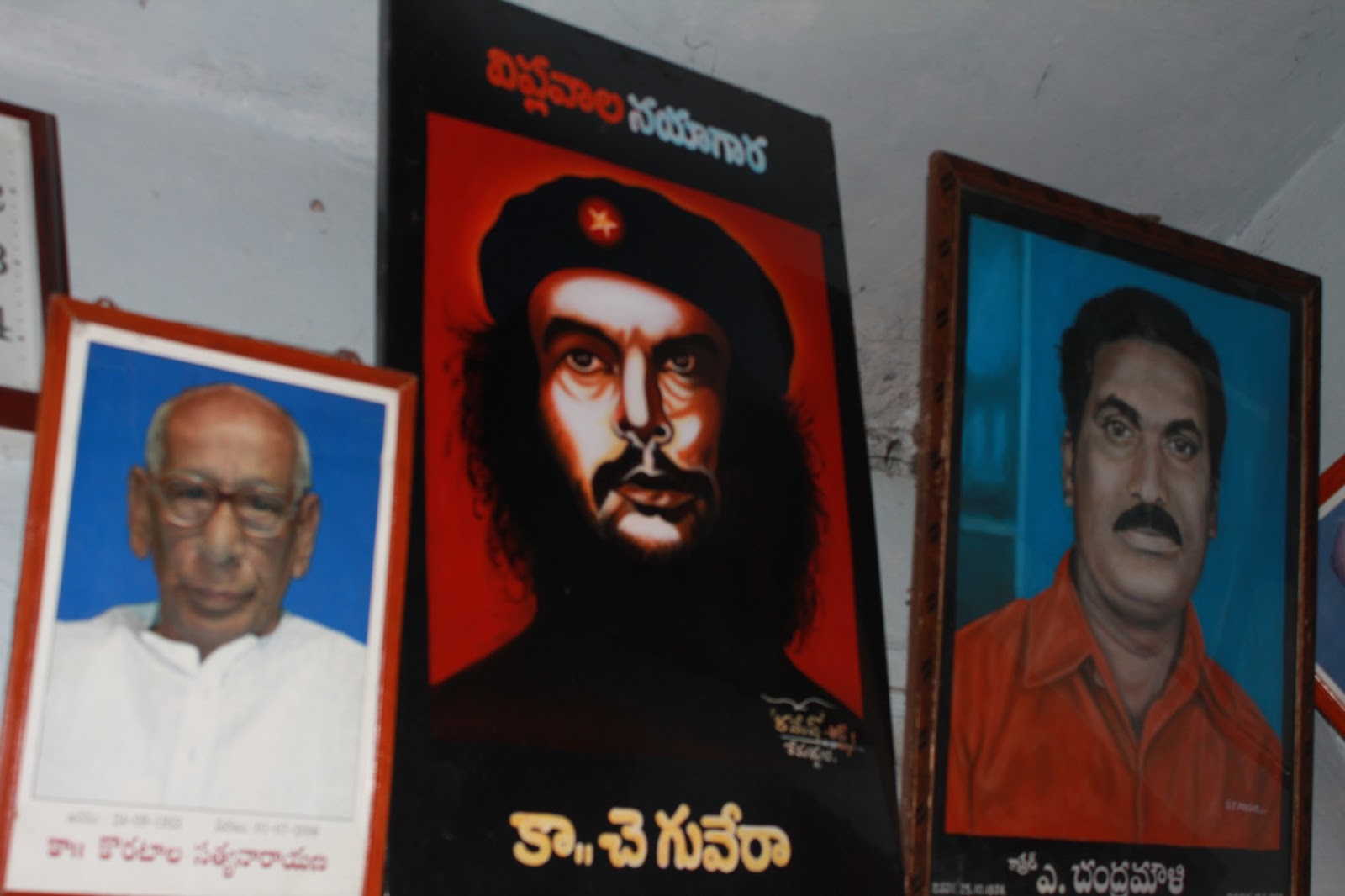
The rush upon reaching the bus stop at Mahabubnagar is in sharp contrast to the quiet of the journey. We are first ushered to the CPI (M) office. Pictures of former leaders adorn the walls, among them towers the garlanded image of the revolutionary Che Guevara, showing at once that he is of them, but also above them. While we take in the details of the room, others walk in and we learn about migration, water shortage, poverty and other problems that the district has been facing. 


Guerrillero Heroico, the famous photograph of Che Guevara


Children outside the office

We scribble furiously in our notepads, a name here, a keyword there, trying to keep up with the flow of the narrative, eager not to miss out any vital detail. In so doing, some of us can already visualize the first drafts of interesting stories.

***

We travel in the shared autos, three at the back, two beside the auto driver in the front and reach the residence of our next host - Dr. V Sreenathachary, Assistant Professor at Palamuru University. We make ourselves comfortable as he tells us about his two world records. We are offered tea in steel tumblers as we listen, rapt. Our water canteens refilled, we are taken to the University. Organized here is an informal interaction with some faculty members and students who share stories of life and livelihood in the district. Their anecdotes give us interesting leads on our different stories.

***

Mahabubnagar was earlier known as Rukmammapeta and Palamuru. At another time, it was known as Cholawadi or Land of the Cholas. It was only in 1890 that its present name was accepted, in honor of the Sixth Nizam of Hyderabad, Mir Mahbub Ali Khan Asaf Jah VI. 

It is not necessary that place etymologies follow similar trajectories. The Pillalamarri, for instance, which is where we are going next. 'Pillalu' meaning children and 'marri' meaning banyan tree, it has been named rightly and the whole area of the tree extends over three acres of land. Under the shade of this majestic, 500-year old tree, we had an unconventional newsroom meeting, discussing the probable merits of our promising ideas.

<3


***

Driving 20 kilometers from Palamuru, we reached Manyamkonda, to the temple of Sri Venkateswara Swamy where a folk ceremony – a jatra – was to take place. We were to witness the raw deal, animal sacrifices and all, and some of us were rather apprehensive about what we would see or experience, once there. Quite clearly, none of us expected a nonchalant ambience. The villagers had retired for the night, under tents in the temple courtyard, the ceremony being long completed. As the temple was located on a hill, we felt lucky to have even reached the top. We missed the jatra but the view of the town lights in the distance under an umbrella of darkness, more than compensates.

***

The Model Town Village of Hajepalli in Farooqnagar Mandal is celebrated for its sanitation. The sun had risen many hours ago, but the villagers were slowly waking up, close to noon; Filling pots of water as they posed for our cameras or answered our questions, asking some of their own. Whether it was because it was a Friday and the beginning of the weekend or because nearly half the day was over and hence the lethargy or every day is similarly relaxed in a village, it was difficult to understand.


***

As we cross National Highway 7, we see how it not only divides those who might earlier have been neighbors, but also cuts across the wilderness, as the only sign of Development in an untamed expanse. Along with the neighboring village of Mudireddipally and the tribal hamlet of Gundlagadda Thanda, Polepally is the site of an SEZ project, covering more than 1000 acres. 

The villagers are happy to share their experiences with us. Most of us try to listen even if we cannot understand Telugu, but some of us are distracted by the cameras in our hands. Suddenly, the quiet group around us turns into a melee. The women seem to be disturbed by something, visibly agitated. Is it something we have said? But the conversation seemed polite, if not amiable. Then, was it something we did? We did take pictures without permission, I thought, guiltily. It wasn't that, either, thankfully.

They mistook one of our reporters for a supervisor of the SEZ project, especially one they had particularly disliked. It took the better of our persuasive abilities to tell them that our friend is only a doppelgänger, an innocent student.

***

Our stop for the night was in the village Atmakuru. We were a lively bunch during dinner, recalling the day's events and exchanging our observations. It was time for another newsroom meeting, this time, under a bright starry sky.

***

We stop at the Priyadarshini Jurala Project, a replica of the Nagarjuna Sagar Dam, 17 kilometers away from Atmakuru. The dam has more than 70 gates and five hydroelectric gates for producing electricity. There are many irrigation and hydro electric projects, which were constructed across River Krishna in the state but this project is the first one among them. Although it is located in Mahabubnagar district, it also supplies water for irrigation to thousands of acres of agricultural land and drinking water to many villages and towns across the state.

***

History is an odd subject. It attempts to bring us stories from the past, stories that need to be read and heard, but amidst the multitude of stories, it forgets that there is no correct story. Each story is vital to the teller, who then brings her own thoughts and perceptions in the telling. Our visit to the Gadwal Fort reinforced this idea. 

The Gadwal Samsthan was ruled by a local ruler called Somashekar Ananda Reddy, fondly called Somanadri. The Samsthan developed around a fort built by the ruler. Our two groups came back with two intriguing stories about the Fort, two contradictory accounts. That the Fort was built by the king to safeguard his kingdom and a human sacrifice was essential for the purpose, was the common thread in both accounts. While one group was told that an impregnated woman was the victim of the sacrifice, the other group talked of an unmarried young man. Which story was true, we wondered. Perhaps that didn't matter because it could be possible that both were true. What of the possibility that there was an unheard third version, which could be closer to the truth than the two we had heard? What is this elusive thing called the truth and why do we pursue it so desperately and determinedly?

Parts of the Gadwal Fort are now used as Maharani Adi Laxmi Devamma Degree and Junior colleges. With about ten functional classrooms, this institution (affiliated to the Osmania University) caters to more than 2000 students. Students from nearby Alampur also come here to study, since there are no colleges in their constituency. 

Remains of old cobwebs accommodating new ones, hang in the corners of the walls in the physics laboratory. The instruments are locked away in the cupboards, either due to lack of use or overuse, it is hard to tell. A part of the structure was renovated recently, I am told. The blue color of the walls is the only testament to that fact because apart from that, not much looks different. Patches of the previously blue wall reveal a shade of yellow, like an incompletely peeled orange. There are challenges to the revival of historical monuments, a teacher at the college tells me. I agree. Should the old remain as it was, in nostalgia of past glory? Or should we restore and maybe renew, because what's lost has been long gone, anyway?

***

We are going to the Mandal Office of Gattu Mandal, which has the jurisdiction of 42 villages. According to governmental records, these villages have the worst sanitation and lowest literacy levels in the country.

Getting lost, in space and time, would be very easy here. If you didn't have a watch, it would be quite impossible to tell the minutes from the hours; telling time through the length and position of shadows would be of no help either, since the sun is overhead for major part of the day. In the moving vehicle, I can feel the hot wind on my face; there are few trees but the leaves rustle on none.

As we cross this desolate terrain, I remember words from Eliot’s The Waste Land,
"What are the roots that clutch, what branches grow
Out of this stony rubbish? 
Son of man, you cannot say, or guess, for you know only
A heap of broken images, where the sun beats, 
And the dead tree gives no shelter, the cricket no relief, 
And the dry stone, no sound of water."

The rural countryside is an ideal landscape to observe and study contrast. Driving through this drought-hit, semi-arid plain, we come across fields of paddy, so richly green, it's an eye-sore. We pass some unfinished modern structures, perhaps a school or an office, who can tell. We can see cattle grazing, rather fishing for grass under the rocks and boulders. The shepherd seems to be playing the game of hide and seek, and clearly, winning. 

Finally, we see some shanties, makeshift dwellings with doors of wood, half broken, and thatched roofs, denoting a neighborhood. Motorbikes from Hero Honda are parked outside a few. We reach the Mandal office and talk to some villagers. We notice that every one of them, young or old, carries on his person, a cell phone. The paradoxes of necessity, the realities of modernity and of existence.

***

We start early next morning. The sun is rising in the distance, but when I look into the viewfinder of my friend's camera, mounted with a telephoto lens, I can see it much closer. The orange and yellow hues from the sun obliterate the darker stretches in the sky. Pleasant and cheerful, the continuous chatter of the birds and the chirping of the crickets - the elements of a memorable day.

We are taken to a sugar factory, to understand and appreciate the working of India Inc. Industry is the backbone of the economy, we've been told ad nauseam. But industries cannot be located in cities or other heavily populated areas, for very many reasons. And yet, they are indispensable. The alternative is to have them in remote areas, away from the city, in the countryside – the synonyms of villages. 

The monstrous factories thus, stand sprawled on the rural land, blowing hot and cold. 

***

As we wait at the Mahabubnagar Bus Stand, we have another journey that we must take, before our trip comes to an end. What follows, will be another set of stories. Perhaps life is a tale of endless travel, from one place, space and time to another.


Together, forever.


Monday, February 04, 2013

Mana Hobbit, Mana Hridayam


As an avid reader, I believed that no matter how appealing the visual adaptation of a story is, the book is always better than the movie. Fewer exceptions existed and those that did, turned my belief over 360 degrees. Adapted from J. R. R. Tolkien’s books, The Lord of the Rings series became one of the most highly acclaimed, heavily awarded and the highest grossing films of all time. Despite taking more than eight years to complete the series, the films did not (and could not) exhaustively follow the books. But what Director Peter Jackson did do and like none other, was demonstrate how a classic can become larger than life.

Written as a children’s fantasy book, The Hobbit became, though was initially unintended to be the forerunner to The Lord of the Rings series. The Hobbit was primarily the mythical tale of a hobbit’s adventure. It was only in the second edition that Tolkien introduced The One Ring, thereby heralding the LOTR.

The Hobbit: An Unexpected Journey is the first part of the trilogy. The excitement in the Shire for Bilbo Baggins’ birthday party and the living room of Bag End where Bilbo writes his book are reminiscent of The Fellowship of the Ring made twelve years ago, but Peter Jackson makes it seem like it was yesterday. A smooth transition takes us back in time, presenting a much younger Bilbo (Martin Freeman). We revisit Tolkien’s Middle-Earth through the Shire and Rivendell but this picture is reconstructed as we are introduced to another world existing parallely – that of the dwarves.

If you’ve read the book, you already know what happens. But how it unfolds visually, aesthetically and emotionally is what makes watching the film a transcendental experience. If on the other hand, you haven’t, that’s the (only) thing separating you from a fan.

To say that Peter Jackson demonstrates sheer brilliance in direction, is to state the obvious.

There were movies. And then there were The Lord of the Rings.
With The Hobbit, the story continues.